Investing in Dubai Real Estate: The Complete 2026 Guide for Foreigners
A complete 2026 breakdown of investing in Dubai real estate for foreigners — real benefits, the step-by-step buying process, full fee schedule, honest pros and cons, and a UAE-wide comparison. Built around the most-searched questions investors are actually asking.
If you've searched anything close to "why invest in Dubai real estate," "is it worth investing in Dubai," or "how can I invest in Dubai real estate," you've probably noticed the same handful of questions keep coming up. Is it actually worth it? Can foreigners really own property outright? What does the process look like, and what's the catch?
This guide answers all of it in one place: the real benefits of investing in Dubai real estate for foreigners in 2025–2026, the honest pros and cons, a step-by-step breakdown of how to invest in Dubai real estate, and what it actually costs.
Is Investing in Dubai Real Estate Worth It in 2026?
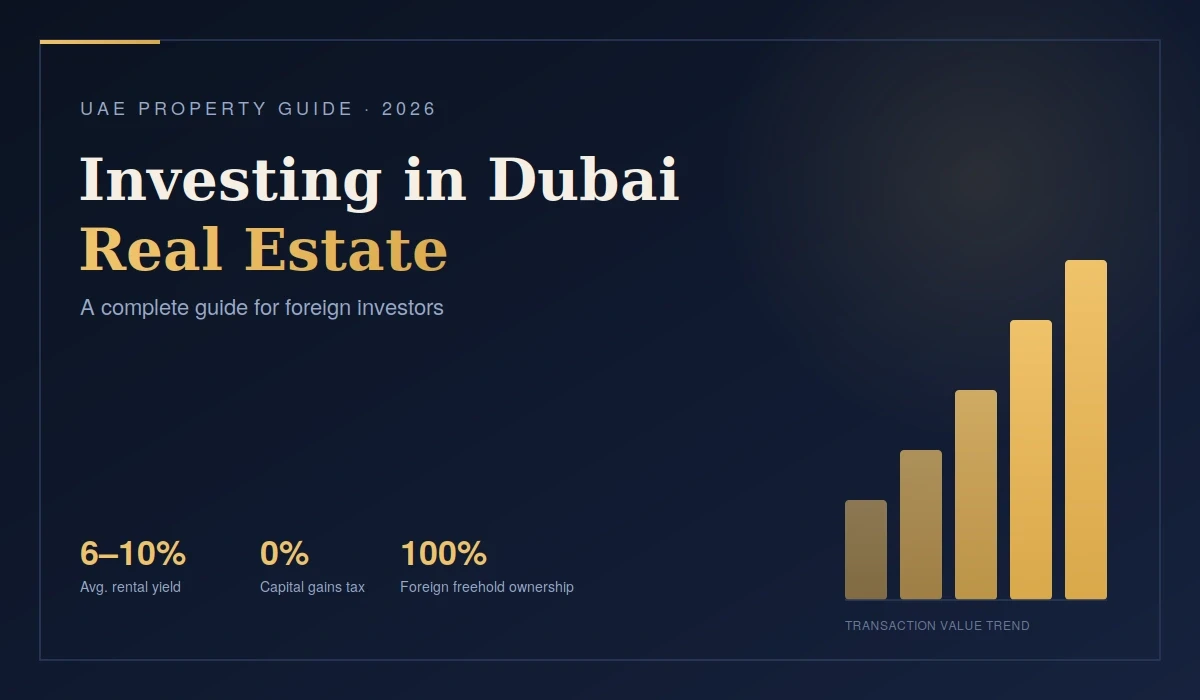
Short answer: for the right buyer, yes — and the numbers back it up. Dubai recorded roughly 270,000 property transactions worth about AED 917 billion in 2025, a year-on-year jump of close to 29% in value. Average gross rental yields across the city run 6–10%, with an average return of around 7.5% across major residential zones — well ahead of mature markets like London, New York, or Singapore.
That said, "worth it" depends on what you're optimizing for. If you want high yield, tax-free income, and a liquid resale market, Dubai is hard to beat. If you want guaranteed, low-volatility appreciation with zero hands-on management, it's a different conversation — every investment in Dubai real estate carries the cyclical risk common to any property market.
Benefits of Investing in Dubai Real Estate for Foreigners
These are the advantages that consistently bring foreign capital into the city.
1. Full freehold ownership — no local partner required. Foreigners can own property in Dubai under 100% freehold ownership, meaning you hold the title deed in your name with no local partner, no sponsor, and no expiry date. This applies whether you're buying as an individual or through a company.
2. No residency required to buy or to keep owning. Your property ownership isn't tied to your residency status — you can own property in Dubai while living anywhere in the world, and thousands of non-resident investors manage their properties remotely through a property management company.
3. A genuinely tax-light structure. There's no annual property tax, no tax on rental income, and no capital gains tax on profits from selling residential property in Dubai. The only major upfront cost is the one-time DLD transfer fee.
4. Strong, comparatively high rental yields. Average return on investment in Dubai real estate runs between 5–9% depending on market conditions and location, with some communities pushing into double digits.
5. A residency visa pathway. Minimum investment for the 10-year Golden Visa is Dh2 million, which can be a single property or a portfolio totaling that amount, and there's no minimum stay requirement — residency remains valid even if you stay outside the UAE for more than six months. Lower-threshold visa routes also exist for smaller investments.
6. Deep, liquid resale market. Dubai's secondary market activity rose to 41.1% of all residential transactions in H1 2025, far above the under-20% resale participation seen in many emerging markets — meaning you can typically exit a position without excessive delay.
7. Global demand keeps the market diversified. Buyer nationalities span the globe, which reduces the market's dependence on any single source economy and adds a layer of demand stability that single-nationality-driven markets don't have.
How to Invest in Dubai Real Estate: Step-by-Step
Here's the realistic sequence, whether you're buying ready or off-plan.
- Choose your freehold area and property type. Non-GCC foreigners can only buy in designated freehold zones — over 60 of them as of 2026, including Dubai Marina, Downtown Dubai, Palm Jumeirah, JVC, Business Bay, and Dubai Hills Estate. Always verify the specific building's freehold status before committing, since the designated-area map is precise to the plot.
- Verify the seller and the title. Confirm ownership through the DLD or the Dubai REST app before signing anything — this is the single biggest safeguard against fraud in a foreign purchase.
- Sign the Memorandum of Understanding (MOU / Form F) and pay a standard 10% deposit.
- Apply for the No Objection Certificate (NOC) from the developer, confirming no outstanding service charges. This typically takes 3–5 working days.
- Complete the transfer at a DLD-approved Trustee Office. Pay the 4% DLD transfer fee plus admin charges; the title deed is issued in your name, often the same day for cash purchases.
- For off-plan purchases, your payment is registered through the Oqood system instead, which converts into a full title deed once the project completes and handover occurs.
For ready properties, the full process from signed MOU to title deed typically takes two to six weeks. Off-plan and mortgage-financed purchases can take longer.
What It Actually Costs: Fees and Budget
Budget 7–10% on top of the purchase price for total acquisition costs. The main components:
| Fee | Typical Cost |
|---|---|
| DLD transfer fee | 4% of purchase price |
| Title deed admin fee | AED 580 |
| Trustee office fee | AED 2,000–4,200 |
| NOC fee (developer) | AED 500–5,000 |
| Agency commission | 2% + 5% VAT |
| Mortgage registration (if financing) | 0.25% of loan + AED 290 |
| DEWA security deposit | AED 2,000 (apartment) / AED 4,000 (villa) |
If you're financing with a mortgage as a non-resident, expect loan-to-value ratios around 50–60%, slightly higher interest rates than residents receive, and additional documentation including bank statements and an income or salary certificate.
Buying Property in Dubai: Pros and Cons
A fair, non-sales-pitch look at both sides.
Pros
- Full freehold title in designated areas, with the right to sell, lease, mortgage, or pass the property to heirs
- No income tax, capital gains tax, or annual property tax
- High rental yields relative to most global cities
- A residency visa pathway tied directly to investment value
- A transparent, regulated process through the DLD and RERA
- Strong infrastructure and continued population growth supporting long-term tenant demand
Cons
- Foreign ownership is restricted to designated freehold or leasehold zones — you can't buy absolutely anywhere in the city
- The market is cyclical and sentiment-driven; double-digit annual growth (like 2023–2024) isn't guaranteed to repeat
- Off-plan purchases carry developer and delivery risk, even with escrow protections in place
- Service charges, maintenance, and vacancy periods typically reduce net yield 1.5–2 percentage points below the advertised gross figure
- Inheritance defaults to Sharia principles unless you register a will through the DIFC Wills Service Centre
- Non-resident mortgages come with lower loan-to-value ratios and somewhat higher rates than resident financing
UAE-Wide: Real Estate Investment Beyond Dubai
If your search extends to "real estate investment in UAE" more broadly, it's worth knowing Dubai isn't the only freehold option. Abu Dhabi allows foreign freehold ownership in designated zones like Reem Island and Reem Hills, with rental yields averaging 6–8% and price growth projected at 3–6% annually. Abu Dhabi's real estate transaction value grew more than 40% in the first half of 2025 alone — a sign that investor attention is broadening across the UAE, not just concentrating in Dubai.
The fundamentals — freehold title, no annual property tax, a title deed system backed by a land department — carry over across emirates, even though specific yields, price points, and buyer profiles differ.
Frequently Asked Questions
Is buying property in Dubai a good investment? For investors prioritizing rental yield, tax efficiency, and liquidity, yes — current data supports it. It's less suited to anyone expecting guaranteed, hands-off appreciation with no market risk.
Do I need UAE residency to invest in Dubai real estate? No. Foreigners can buy freehold property without holding a UAE residency visa or having a local sponsor.
Can foreigners get a mortgage to buy property in Dubai? Yes, through several UAE banks, though typically at lower loan-to-value ratios (around 50–60%) and slightly higher rates than residents receive.
What's the minimum investment for a Dubai residency visa? Visa thresholds vary by route — roughly AED 750,000 for a 2-year property visa up to AED 2 million for the 10-year Golden Visa.
Is Al Ain or Abu Dhabi a good alternative to Dubai for property investment? Yes, for investors wanting lower entry prices and steadier, more locally-driven demand. They're a different risk and liquidity profile from Dubai, not a direct substitute.
What's Your Reaction?
 Like
1
Like
1
 Dislike
0
Dislike
0
 Love
0
Love
0
 Funny
0
Funny
0
 Wow
0
Wow
0
 Sad
0
Sad
0
 Angry
0
Angry
0

Mr. Rizwan writes about Dubai and UAE real estate, including property news, market trends, off-plan projects, buying guides, rental updates, and investment insights. His work helps readers understand the UAE property market with clear, practical, and easy-to-read information.





Comments (0)